|
Click
here
to see behind-the-scenes pictures and read a fan review of this performance!
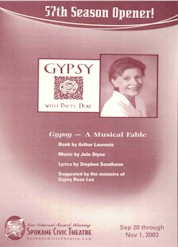
"Gypsy"
September
20 - November 2, 2003
Suggested
by the memoirs of Gypsy Rose Lee
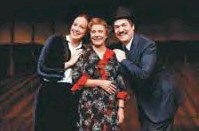
Starring
(in order of appearance):
Uncle Jocko:
Jim Phillips
George: Steve Whitehead
Balloon Girl: Ashlyn Coston
Kiddie Show Contestant: Serena Caryl
Kiddie Show Contestant: Madelyn Davis
Kiddie Show Contestant: Mackie Hockett
Kiddie Show Contestant: Kelly Kopczynski
Kiddie Show Contestant: Chloe Maier
Kiddie Show Contestant: Mary Ormsby
Kiddie Show Contestant: Gracie Kiernan Smith
Kiddie Show Contestant: Noel Wamsley
Baby Louise: Aimee Paxton
Baby June: Kate Cubberley
Rose: Patty Duke
Pop: Homer Mason
Newsboy: Alex Anderson
Newsboy: Zachary Jackson
Newsboy: Hunter Klaue
Weber: Lee Hatley
Herbie: Reed McColm
Louise: Danae M. Lowman
June: Andrea Westerman
Tulsa: Greg Pschirrer
Yonkers: Matt Dennie
Angie: Ronny Oliver
L.A.: Jon Lutyens
Kringelein: Buddy Todd
Mr. Goldstone: Hyrum Lowder
Miss Cratchit: Toni Cummins
Agnes: Katy Fitzpatrick
Marjorie May: Angela Snyder
Thelma: Alayna Caryl
Edna: Amalie Marte
Pastey: Buddy Todd
Tessie Tura: Maria Caprile
Mazeppa: Kate Vita
Cigar: Steve Whitehead
Electra: Chasity Kohlman
Showgirl: Amy Newbold
Showgirl: Alyssa Calder
Showgirl: Amalie Marte
Showgirl: Katy Fitzpatrick
Maid/Waitress: Tristen Canfield
Phil: Sheldon Rippee
Bourgeron-Cochon: Jon Lutyens
Written by:
Arthur Laurents
Directed by: Marilyn Langbehn
Music by: Jule Styne
Lyrics by: Stephen Sondheim
Music Direction by: Carolyn Jess
Conducted by: Scarlett Hepworth
Choreographed by: Kathie Doyle-Lipe
Direct from Broadway, Patty Duke returns to Spokane Civic Theatre as the
Mother of All Stage Mothers in one of the most popular musicals of all
time. Filled with unforgettable songs ("Everything's Coming
Up Roses," "Let Me Entertain You," "Together
Wherever We Go," among others), this story of love, ambition and
the Birth of Burlesque is certain to be one of the season's highlights!


The
Spokesman Review
'Gypsy'
Boasts Talent from Top to Bottom
September 22,
2003
by Jim Kershner
Patty Duke is absolutely terrific as Mama Rose, the mother of all stage
mothers. We'll discuss her in a minute, but first I should point
out that the Spokane Civic Theatre's version of "Gypsy," is by
no means a one-woman show. This production is loaded from top to
bottom with effective and polished performances. That's deeply
impressive in a community theater production with a cast of 40-plus.
This show has a top-notch Herbie (Reed McColm), a national-class Louise
(Danae M. Lowman) and a stellar collection of strippers, tap-dancers,
showgirls and just about everybody else. That's a credit to
director Marilyn Langbehn, who fulfills one of the most important
obligations of a director: Put everyone in a role in which they can
succeed.
And
succeed "Gypsy" does, with just the right combination of
well-timed comedy, honest drama and exuberant musical numbers. And
yes, it certainly has a charismatic performance by Duke. She wraps
that Duke energy and intensity completely around the role of Mama
Rose. Better singers have tackled this role (actually, there are
better singers on this stage), but few have made Mama Rose quite so
vivid, so tough and so terrifying. Duke draws on her own
experience as a child actor to create a bull-headed force of nature, a
woman who simply will not rest until she has made her girls into stars.
If you want a lesson in what separates an Oscar and Emmy winning actress
from a merely good actress, just listen to Duke's speaking voice.
She can make it harsh as gravel, as sweet as syrup and as tough as
nails. Her line-readings are full of an almost musical kind of
vocal variety. Her singing, on the other hand, is not her strong
point. This is not an insignificant issue, since Mama Rose has to
carry many of the most memorable Jule Styne-Stephen Sondheim songs,
including "Small World" and "Together Wherever We
Go." Duke sells these songs on pure dramatic aplomb, and she
turns the climactic "Rose's Turn" into an intense and
effective little psychodrama. And she sounds like an
honest-to-goodness belter in "Everything's Coming Up Roses."
For
terrific singing, however, you can't beat "If Momma Was
Married" a beautifully harmonized duo by Lowman and the excellent
Andrea Westerman as her sister June. Lowman is also a fine
actress. She makes a completely believable transition from mousy
Louise to the brazen Gypsy Rose Lee, the most famous stripper in
America. McColm is perfectly cast as the long-suffering Herbie,
the man who waits patiently for Rose to come to her senses and marry
him. McColm brings a sense of decency and resignation to the role.
There
are too many fine supporting performances for me to cram into this
space. I mean it when I say this cast had no weaknesses. But
I must mention the outstanding performance by Greg Pschirrer as Tulsa,
who nails the big "All I Need is the Girl" dance number, along
with Lowman. And I was completely blown away by the trio of
strippers in the hysterical "You Gotta Get a Gimmick"
number. Kate Vita was a blast as the trumpeter Mazeppa, Maria
Caprile was a delicate flower as the "refined" Tessie Tura and
Chasity Kohlman was sparking as the electrified Electra.
The
nine-piece orchestra, conducted by Michael Muzatko and musical-directed
by Carolyn Jess, had a full and brassy sound. Set designer Nik
Adams gave us a feel for what vaudeville looked like, both onstage and
backstage. He also gave us a bright red burlesque theater in the
second act, complete with Gypsy Rose Lee's name in lights. As
Gypsy says, "Let me entertain you." And does this
production ever deliver.
The
Pacific Northwest Inlander
Slugline
Fall Arts Theatre - Gypsy At The Civic
September 12,
2003
by Michael Bowen
From 1959-61, both The Miracle Worker and Gypsy were running on
Broadway. The little girl who starred as Helen Keller in the one show
was already known as Patty Duke; now, four decades later, the woman who
has become Anna Pearce has the lead role in the other play, Gypsy.
And
she'll be playing it right here in Spokane. Back in the early '60s,
however, Anna Marie Duke was effectively ripped from her family by a
couple of domineering managers, John and Ethel Ross, who stole Anna's
independence and even her identity, renaming her Patty. There's a
multilayered irony here: "Patty Duke," who was once pushed
around--and worse--by a couple of complete control freaks, will now
tackle the role of Mama Rose, the Mother of All Pushy Stage Mothers from
Hell. In her real-life youth, she was the tyrannized child; now she's
going to be the onstage tyrant. Will she be drawing on the oppression
and abuse of her past?
"I didn't want to, but I've had to," she admits. During
rehearsals, she says, "I still go to negative memories, little
vignettes of the Rosses. There are some lines in the show--some of
them are others', but some of them are mine--that are verbatim,"
she emphasizes.
And Duke--married to Mike Pearce for 17 years now and currently a
North Idaho resident--has been willing to draw on that past while
rehearsing Gypsy. At a recent rehearsal, says director Marilyn
Langbehn,
"Anna shared her experiences with the Rosses, reconciling what
their love looked like with her later experiences of that same emotion.
The actors were just like sponges," says Langbehn. " And it was
the good work of actors communicating, not just the sharing of stories
by some person who's famous, which is not necessarily helpful to the
creation of the character. There's a difference."
Duke certainly understands the difference between Rose and a girl like
Louise, the daughter whom Mama first overlooks and then exploits. That's
because, four decades later, Anna Pearce is still performing for the
Rosses: "I want to show them," she says, with intensity,
"even though they've passed over to the other side--that now,
with the right kind of support and more skilled teachers, I can do
it!"
Louise transforms herself into the phenomenon of Gypsy Rose Lee; by a
similar effort of will, Anna changed herself into Patty and then back
again. There's a long tradition of actresses climbing the mountain that
is Mama Rose: Ethel Merman, Rosalind Russell, Angela Lansbury, Tyne
Daly, Bette Midler, Bernadette Peters. Standing 5 feet tall, Duke seems
less likely to belt out the role Merman-style than to follow Peters'
strategy of the petite woman connecting with the role's vulnerability.
But just now, the stage veteran has her mind more on logistical than
theoretical matters. She laughs at the forgetfulness that comes with
age: "It's interesting--I've shifted my concern from 'Will I be
able to sing that song, to dance that dance?' to 'Will I be able to
remember the words?'"
And it can be taxing, this spending three months with a character who's
unlikable in so many ways: "There are times," says Duke,
"when I'm on stage and my mind wanders, and I think, 'I'm fine, my
life is fine.' Why am I putting myself through this?!"
By sheer force of will, Mama Rose rises from a series of defeats in
Gypsy to insist that everything nevertheless is coming up--can't help
but be coming up--roses. With similar effort, Anna wrenched herself
away from Patty and became, once again, Anna.
The result of all that effort and the product of all those ironies will
hold sway on the Civic's Main Stage from Sept. 20-Nov. 2. If the
production succeeds, our memories of the Patty Duke who has become Anna
Pearce will stay with us for a long time--together, wherever we go.

The Spokesman Review
Gypsy Girl
September, 2003
by Jim Kershner
Patty
Duke admits that she is not as "technically equipped" as Ethel
Merman, for instance, to tackle the role of Mama Rose in the Spokane
Civic Theatre's upcoming "Gypsy."
"I
wouldn't know a B-flat from a Q," Duke allowed, with that throaty
laugh familiar to generations of TV viewers. Yet she brings
something just as important to Mama Rose, a character who has come to
define the term "pushy stage mother."
"I
get to bring my insights which come from being a kid actor," said
Duke, who goes by the name of Anna Pearce around the
Coeur
d'Alene
area, where she has lived for 14 years. "I
didn't have a mom like Rose, but I had a couple who called themselves
managers, and she was like Mama Rose, a good deal. Only she would
never let it be seen in public, it was all behind the scenes."
Duke
said she remembers hearing variations on Mama Rose's favorite lines many
times when she was a child.
"One
that's close was (in stern, commanding voice), `Now, be sure when you go
out there, you sparkle! Sparkle!' And I didn't think I was
sparkling until my eyes were rocketing around in my head."
So
she has always been drawn to "Gypsy." And in idle
backstage chats during her previous Civic appearance in "A Glass
Menagerie" in 1999, she let it drop that she had always coveted the
part of Mama Rose.
"But
after that there were times when I said, `I'm too old now, it's too big,
too much, the energy is enormous,”' said Duke. “Unfortunately,
when Jack (Phillips, Civic executive director) and Marilyn (Langbehn,
the show's director) said we could do this show, my ego said, `OK!
One more time!”'
Mama
Rose does have some big musical numbers, including the climactic
“Rose's Turn.” Duke said that she has received outstanding
coaching from voice teacher Scarlett Hepworth, music director Carolyn
Jess and conductor Michael Muzatko.
“They
have taught me everything by ear,” said Duke. “They have
spoon-fed me every single note.”
Duke
also has effusive praise for Langbehn and for the other members of the
cast. Danae M. Lowman plays Louise, the title character who grows
up to become the famous stripper, Gypsy Rose Lee. Aimee Paxton
plays the young Louise, Kate Cubberley plays Baby June and Andrea
Westerman plays Dainty June. Reed McColm plays the long-suffering
Herbie.
It's
not like Duke is a complete novice when it comes singin' and dancin'.
She did 10 weeks on Broadway last year in the role of Aunt Eller in the
revival of “
Oklahoma
!”
“Seeing
all of those dancers and musicians, if you keep your ears open, you
can't help but learn some things,” she said.
And,
of course, Duke is the opposite of a novice when it comes to
acting. She has won an Oscar and numerous Emmys. She was
acting on Broadway, as Helen Keller in “The Miracle Worker,” when
she was 12. That's
when she first developed the urge to be in “Gypsy,” which was
playing down the street.
“A
number of my friends were in it,” she said. “I always felt
left out, because they were all going off to sing and dance and have a
great time, and I was going off to do this sad, depressing play.
Which it turned out not to be.”
Duke
has plenty of time these days to fulfill her dream of being in
“Gypsy,” partly because her TV career has slowed to a crawl.
“I
have recently decided that, as far as I know, certainly in TV, I have no
career,” said Duke, 56. “I thought I was a staple of TV who
would go into her octogenarian years sort of being around somewhere on
the channel. But the first mistake is, if you're a woman, don't
turn 50. And my God, don't turn 55.”
But
she also thinks another factor is working against her--and against most
other actors, for that matter.
“I'm
sorry if this sounds like sour grapes, but: reality TV,” said
Duke. “My mainstay was two-hour movies. I made a very nice
living doing two-hour movies, with very little effort, I'll admit, on my
part.”
Now,
she says, “They just don't make them. It's been like this going on
three years. `
Oklahoma
!'
was a shot in the arm spiritually. `Gypsy' will be that for me,
too. But nothing is coming into the coffers.”
The
situation has reached the point where she and her husband, Mike Pearce,
have decided to sell the 80-acre farm they live on in Hayden.
“We'll
have to buy another home,” she said. “We'll have to downsize,
and in some ways I can see some positive things about that. Less
of a house to clean--we don't have people that work for us, it's just
us. We'll miss the animals terribly, but also we won't have to go
out when it's 15 below and give somebody hay and water.”
Will
they stay in the area?
“Oh,
yes,” she said, with a laugh. “We're Idahoans. We're
stuck.”
She
said they want to stay in the Lakeland School District so that their son
Kevin, 14, can continue in the same schools.
Duke
does have one idea that would suit both her financial and artistic
needs.
“In
an absolutely perfect world, I would get some fabulous commercial for
some medication that I already take and be a spokesperson for that, and
then do theater,” she said. “Wouldn't that be great? One
supports the other? I'm working on it. I've taken enough
medication!”
Meanwhile
she is warmed by the success of her son Sean Astin, who plays the hobbit
Sam in the mega-hit “Lord of the Rings” film trilogy.
“I
saw the second movie (`The Two Towers') in
Times
Square
,
and I was the only one sobbing whenever Samwise Gamgee came on,” she
said. “The
rest of the audience was thinking, `What is the matter with that
lady?”
The
Pacific Northwest Inlander
Let Them Entertain You
Setember 25, 2003
by Michael Bowen
In
the movies of our lives, we are all, each one of us, the star.
Other people come and go, playing their petty parts, but I, me,
myself—there's the focus. We lead our lives for ourselves, full
of ourselves.
As a self-centered manipulator, Mama Rose lives life by herself.
In the current production of Gypsy at Spokane Civic Theater (through
Nov. 1), Patty Duke warms slowly to the role, then nails the part's
hollow self-promotion.
For Mama not only insists on being the star of her own show—she
shanghais the people around her, even coerces her own daughters to star
in a play of her own imagining. The play's really about her,
always about her—except that she can't fill the role herself.
"If I coulda, I woulda—that's show business," she murmurs
near the end, and it's a line that rescues her from a vortex of egotism
and insanity.
Gypsy's subtitle, after all, is "A Musical Fable": There's a
moral lesson to be learned here, and it's not one that thinks highly of
Little League dads or beauty pageant moms.
Or of moms like Mama Rose, who push and prod their kids. We meet
some of those stage mothers in the opening sequence, which has good
energy, with a half-dozen kids jostling around while auditioning for
Uncle Jocko (Jim Phillips, in a strong comic turn). The scene
manages to avoid most of the saccharine cutesiness usually associated
with such scenes. But Duke isn't as overbearing in this scene as
Mama needs to be: Mama is funny in this scene, but she's also a driving
force.
They're packin' 'em in for Gypsy because of the name on the marquee.
And Patty Duke is accomplished, even haunting, in the two act-ending
finales, "Everything's Coming Up Roses" and "Rose's
Turn." Singing is not her strong suit, but dramatic acting
is, and that gift merges into the context of "Roses" so
powerfully that everyone comes out smelling quite nice, indeed.
But Duke's performance isn't the only reason to see this version of the
tale of Mama Rose and her two daughters, her would-be husband and her
own insecure little self.
In fact, the first half of the first act seemed flat: Duke's voice was
sometimes scratchy, the pace was down and the book subjects us to a
series of painfully amateurish (funny, but still painful) little kids'
vaudeville acts. The silliness of "Mr. Goldstone" seems
designed just to throw in another fun number.
But then suddenly, midway through the first half of the show, Louise
solos in "Little Lamb"—a neglected girl's longing—and
Danae Lowman brought so much sad beauty to the moment that we could see,
even in shabby surroundings, the brightness of the star that she would
become.
And the momentum builds from there. Rose and Herbie (Reed McColm)
have their nice little love song in the Chinese restaurant, "You'll
Never Get Away From Me" (where I found myself wishing that Herbie,
and McColm's voice, had a bigger part to play). The voices and
comedic abilities of Louise and the older June, no longer a Baby (Andrea
Westerman), work well together when the two sisters fantasize "If
Momma Was Married."
Greg Pschirrer, as Tulsa, puts on a little tap-dance clinic for
"All I Need Is the Girl," though Lowman brings special
poignance to Louise's faint mimicry of Tulsa's dance moves. She
wants to be his Ginger Rodgers, though at this point she's still being
overlooked.
This is choreographer Kathie Doyle-Lipe's finest moment: She designs the
dance so that Lowman appears full of longing while halting in her
movements, and then somehow finds a more fluid path, merging into
Pschirrer's flashy dancing. They're a team, but only for a moment.
All of which sets up the first-act finale in that Omaha train station.
Given the backdrop later on for the (wonderfully, comically amateurish)
"Toreadorables" number—which takes place in "Desert
Country, Texas"—certainly the Civic could've concocted a railroad
platform in Omaha, with the rails extending out to a flat, desolate
horizon. Instead, director Marilyn Langbehn—along with Technical
Director Peter Hardie and Set Designer and Scenic Artist Nik
Adams—opted in the first-act finale for a minimal set: a single bench
isolated on a cavernous, all-black stage. The effect was funereal.
It accentuates the moment when Mama, despite learning that she's been
deserted not only by most of her vaudeville cast but even by her favored
daughter, nevertheless summons up the gumption (the monstrous egoism?)
to rebound by corralling Louise into the show-biz life that she herself
never had. She doggedly insists that everything's coming up roses,
and we both admire the sentiment and are appalled by it.
Another strong presence in this show is McColm's Herbie, the noble and
all-enduring man who books Rose's shabby shows and puts up with her
selfishness. From his first entrance, in black hat and with a
salesman's tattered samples case, McColm dominates scenes. He and
Duke hold their first tentative handshake, but without getting all
cheesy on us. The script hampers his first meeting with Rose
("Small World"), moving along from chance meeting to joyous
intimacy in about three minutes, but when the number develops into a
hint of a duet, McColm's voice is rich and reassuring, energizing the
end of that song.
The strength of the key players around Rose is echoed in the rest of the
cast. For the backstage visit to a house of burlesque in Act Two,
"You Gotta Get a Gimmick," we meet some of the strippers who
are instrumental in the transformation of Louise into Gypsy Rose Lee.
As Mazeppa, Kate Vita toots a trumpet; Maria Caprile as Tessie Tura has,
er, a distinctive costume trick; and as for Chasity Kohlman's
Electra—well, my sinfulness doesn't derive from staring at her along
with the other two. But it would be sinful to reveal what
Electra's gimmick is. These ain't just broads who show a little
skin; these ladies are true ecdysiasts. (They've earned the title.)
They temporarily steal the show, and they're not afraid to expose either
their idiosyncrasies—or their epidermis—to public view.
For a community theater, this show boasts strong production values.
"Baby June and the Newsboys," for example, features the best
use of a strobe light I've ever witnessed on a stage—anywhere.
There's patriotic bunting being flown in, live animals onstage and all
manner of lighting effects, for which Peter Hardie again deserves
credit: marquee lights, glittery lights, back-lighting effects and more.
At one point, Rose insists that "Everybody needs something
impossible to hope for," and it's good advice. Our lives are wired
for dissatisfaction.
Problem is, Rose chases after her dreams even when it means trampling
someone else's.
Nevertheless, throughout it all, Duke and the rest of Langbehn's cast
grab us by the lapels. Let us entertain you, they seem to be
demanding. And they do. |